
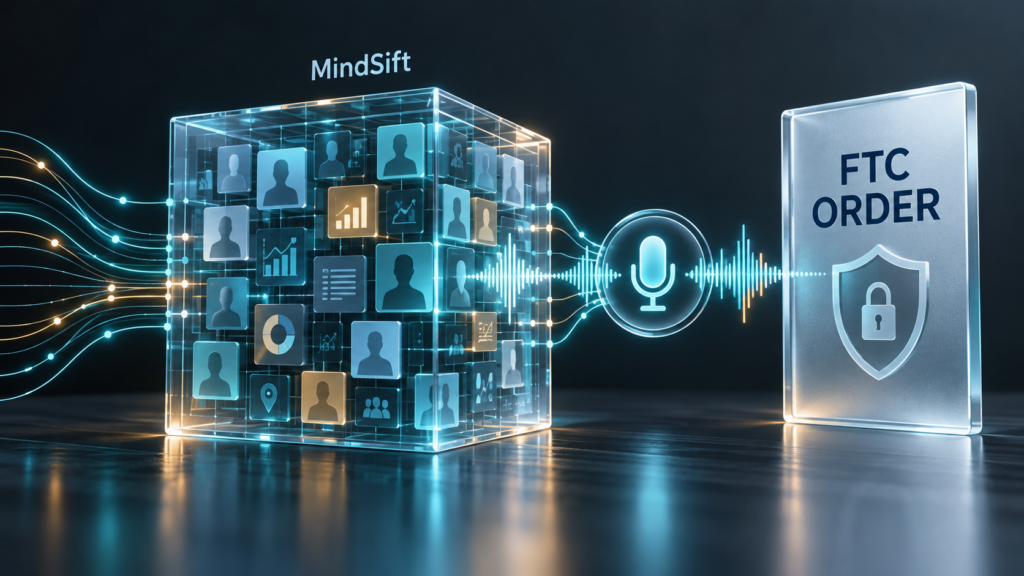
MindSift is a marketing and data technology company that describes its platform as an integrated environment for identity resolution, consumer and business data, audience development, buyer-intent signals and data activation.
The company’s current website positions MindSift as a technology platform for marketers, sales organizations, media buyers and business owners. According to MindSift’s own platform claims, its database contains more than 280 million consumer profiles and 120 million business contacts, alongside tools for identifying website visitors, enriching customer relationship management records, analyzing purchase intent, constructing audiences and activating data across different marketing channels.
MindSift currently promotes several products and capabilities, including Website Visitor ID, Consumer Data, Business Intelligence, Audience Builder, Buyer Intent, Offline Activation and OutReach Mining.
At the same time, the company has an important recent regulatory history involving the Federal Trade Commission.
In August 2026, the Federal Trade Commission (FTC) finalized an order involving MindSift LLC and its former Active Listening marketing service. According to the FTC’s complaint and final order, MindSift had marketed Active Listening as a technology that could use voice-related information from smart devices to identify prospective buyers and support geographically targeted advertising.
The FTC alleged that those representations were deceptive because the service did not actually collect or use voice data in the manner represented.
The final FTC order requires MindSift to pay $25,000 and prohibits specified misrepresentations concerning advertising and marketing services, voice-data collection and use, consumer consent involving voice data and geographic-targeting capabilities.
That regulatory history is relevant when examining MindSift, particularly because its current website continues to emphasize data-driven audience intelligence, identity resolution and marketing activation.
However, the former Active Listening service should not automatically be treated as synonymous with MindSift’s current product lineup. The company’s present platform is centered more broadly on consumer data, B2B intelligence, identity resolution, intent signals, CRM enrichment and audience activation.
What Is MindSift?
MindSift LLC is a New Hampshire limited liability company involved in marketing and data services.
The FTC identifies MindSift’s principal office as 142 Main Street, Suite 405, Nashua, New Hampshire 03060 and describes the company as a provider of marketing and data-brokering services.
Third-party business information has associated MindSift with areas including:
- Audience intelligence
- Lead generation
- Identity resolution
- Data brokering
- Data activation
- B2B data
- Consumer data
- Buyer-intent analysis
- Outbound sales engagement
- Marketing technology
MindSift’s own website uses a somewhat broader technology-focused description, emphasizing its integrated platform rather than simply presenting the company as a data broker.
Its current positioning can be summarized around three interconnected concepts:
Data + Identity + Activation
The basic proposition is that marketers should be able to identify potential customers, understand their characteristics or purchasing signals, construct relevant audiences and then activate those audiences through advertising, sales outreach or other marketing channels.
MindSift’s Current Data and Marketing Platform
The current MindSift website presents its technology as an integrated marketing-data environment.
The company says users can:
- Build targeted audiences
- Identify previously anonymous website visitors
- Enrich CRM records
- Analyze buyer intent
- Find consumer prospects
- Identify B2B contacts
- Create audience segments
- Export audiences
- Activate data through offline marketing
- Send live intent signals into CRM systems
MindSift currently highlights 280M+ consumer profiles, 120M+ business contacts and 60K+ intent categories. The company also advertises a 99.9% uptime SLA.
These figures are claims presented by MindSift itself. They should therefore be understood as company-stated platform figures rather than independently audited measurements.
MindSift Consumer Data
Consumer data is one of the largest components of the platform promoted by MindSift.
The company states that its platform contains more than 280 million U.S. consumer profiles and that those records contain more than 400 demographic, behavioral and intent attributes.
The purpose of this data is to allow marketers to construct more specific audiences instead of relying exclusively on broad demographic targeting.
Depending on the use case, a marketer could potentially define an audience using combinations of attributes such as:
- Age
- Geography
- Household characteristics
- Income
- Homeownership
- Demographics
- Consumer behavior
- Interests
- Intent signals
- Other marketing attributes
MindSift’s website gives examples involving factors such as homeownership, income and age.
Its homepage also presents an example audience called “Direct Mail – Homeowners,” using criteria including homeowners, income above $100,000 and an age range between 30 and 55.
These examples illustrate the platform’s core audience-building concept: marketers can attempt to move from broad population-level targeting toward more specifically defined consumer groups.
MindSift Business Intelligence
MindSift also promotes a substantial B2B data and business-intelligence component.
The company states that its platform contains more than 120 million verified B2B contacts.
MindSift describes this business data as including:
- Firmographic information
- Technographic information
- Organizational charts
- Business contact information
- Company information
- Buyer information
- Decision-maker information
This part of the platform is aimed particularly at sales organizations and B2B marketing teams.
For example, an enterprise software company could potentially use business filters to identify organizations according to factors such as employee count, industry, technology environment or executive position.
MindSift’s homepage illustrates an “Enterprise Decision Makers” audience using criteria such as VP-level job titles, companies with more than 500 employees and Salesforce technology.
MindSift Website Visitor ID
One of MindSift’s prominent current offerings is Website Visitor ID.
The company describes the product as a technology for identifying previously anonymous website traffic.
According to MindSift, the service can provide information such as names, email addresses and firmographic details without requiring a visitor to complete a form.
The website advertises a 70% match rate.
That figure is a company-stated performance claim and should not be interpreted as an independently verified industry benchmark.
How Website Visitor Identification Works
Traditional website analytics can show that an unidentified person visited a particular page.
For example, a company’s analytics system might indicate that an unknown visitor:
- Visited the pricing page three times
- Returned to a product page
- Viewed several comparison pages
- Spent significant time on the site
That information can be valuable, but it does not necessarily reveal the visitor’s identity.
Identity-resolution technology attempts to connect anonymous digital activity with a known individual, household, company or organization.
When the matching process succeeds, an otherwise anonymous website interaction may potentially become an identifiable prospect record.
MindSift positions Website Visitor ID around this basic concept.
Why Website Visitor Identification Matters
Visitor identification can be particularly useful for B2B organizations.
A company may receive substantial traffic to pages such as:
- Pricing pages
- Product pages
- Comparison pages
- Demo pages
- Documentation
- Industry-specific pages
Only a relatively small percentage of visitors may actually submit a form.
The remainder can remain anonymous within conventional analytics systems.
Identity-resolution tools attempt to provide additional information about some of that otherwise unidentified traffic.
That information can potentially help sales teams prioritize accounts or individuals that appear to be showing meaningful interest before they formally submit a lead.
MindSift Audience Builder
MindSift also offers an Audience Builder designed to help marketers create specific audience segments from multiple data attributes.
The company says users can combine available attributes to construct highly targeted audiences and export those audiences to marketing platforms.
MindSift also advertises more than 60,000 segments or intent categories, depending on the particular product context.
Audience creation can involve combinations of:
- Demographics
- Geography
- Business characteristics
- Technology usage
- Consumer behavior
- Intent
- Industry
- Job title
- Company size
- Revenue
- Other available attributes
The objective is to allow businesses to define an ideal customer profile more precisely instead of purchasing generic advertising audiences.
MindSift Buyer Intent Data
Buyer Intent is another central component of MindSift’s current product strategy.
The company states that it offers more than 40,000 intent categories and refreshes signals daily.
The underlying concept is that someone actively researching a product or service may represent a different commercial opportunity from someone who merely matches a demographic profile.
Intent-data systems attempt to identify those signals.
For example, an individual or organization researching subjects such as:
- CRM software
- Home remodeling
- Business insurance
- Enterprise cybersecurity
- Marketing software
could potentially be associated with an audience or intent category involving that subject.
MindSift’s positioning is based on using these signals to help identify individuals or organizations that may be moving closer to a purchasing decision.
Demographic Data Versus Intent Data
Demographic targeting and intent targeting answer different questions.
Demographic targeting generally asks:
Who is this person or organization?
Intent targeting asks:
What might this person or organization currently be interested in purchasing?
For example, a homeowner between 35 and 55 years old represents a demographic profile.
A homeowner who is actively researching kitchen remodeling represents a different type of marketing signal.
Combining demographic information with behavioral and intent information can create a more narrowly defined audience.
That combination is central to the value proposition MindSift presents through its current platform.
MindSift OutReach Mining
Another prominently promoted MindSift product is OutReach Mining.
The company describes OutReach Mining as a real-time intent and CRM-enrichment system.
Its stated purpose is to send live intent signals into a company’s CRM so sales teams can identify when an account begins researching products or services relevant to the business.
MindSift advertises capabilities including:
- Real-time signal streams
- More than 40,000 intent topics
- Less than 60 seconds of latency
- CRM-native operation
- Continuous enrichment
- Buying-stage scoring
- Triggered automations
- Native integrations
The company states that OutReach Mining works with Salesforce, HubSpot, Go High Level and more than 200 other tools.
How OutReach Mining Is Designed to Work
The basic workflow can be described as:
Detect signal → Enrich account → Assess buying stage → Trigger action
For example, if an organization begins showing signals associated with a particular product category, the system could potentially:
- Update the CRM record
- Identify the relevant account
- Add current firmographic or intent information
- Score the account based on buying stage
- Alert a salesperson
- Enroll a prospect in an outreach sequence
- Adjust advertising activity
MindSift states that its system can trigger Slack alerts, sequence enrollments and advertising bid adjustments based on detected signals.
These are capabilities advertised by the company and should not be interpreted as guarantees of a particular sales or marketing outcome.
CRM Enrichment
CRM enrichment represents another important part of the platform.
Many companies maintain customer relationship management systems containing names, companies, email addresses, job information and sales records.
Over time, those records can become outdated.
Employees change jobs.
Companies relocate.
Technology stacks change.
Business priorities evolve.
A data-enrichment system attempts to supplement existing records with updated information.
MindSift says its OutReach Mining technology can continuously enrich CRM contacts with updated firmographic and intent information.
The goal is to make existing sales databases more useful without requiring sales teams to manually research every record.
MindSift Integrations
MindSift’s current OutReach Mining materials identify integrations with:
- Salesforce
- HubSpot
- Go High Level
- More than 200 additional tools
The purpose of these integrations is to place MindSift’s data and signals inside existing sales and marketing workflows.
Integration can be particularly important for enterprise marketing operations because information becomes more actionable when it can move directly into the systems already used by sales representatives and marketers.
Offline Activation
MindSift also promotes an Offline Activation capability.
The company says digital intent signals can be used to trigger physical marketing campaigns involving:
- Postcards
- Letters
- Printed media
MindSift advertises delivery within approximately 48 hours for this capability.
The offering is notable because much of contemporary marketing technology is designed around digital channels.
MindSift’s model attempts to connect online signals with offline marketing.
For example, a prospect demonstrating a relevant online interest signal could potentially become part of a direct-mail campaign.
Audience Activation
Activation is central to the way MindSift describes its platform.
Collecting information is only one part of a marketing strategy.
The next question is how that information can be turned into an action.
MindSift describes the overall process as:
Identify → Segment → Enrich → Activate
Activation can involve:
- Digital advertising
- Direct mail
- Sales outreach
- CRM workflows
- Audience exports
- Other marketing activities
This makes the platform more than a static database in the way MindSift presents its product.
Its stated objective is to transform data into actionable marketing information.
Who Uses MindSift?
MindSift markets its platform toward several categories of users.
Marketing Teams
Marketing departments can potentially use audience data, intent information and visitor identification to build more targeted campaigns.
Sales Teams
Sales organizations can use B2B contacts, intent signals and CRM enrichment to identify potential prospects and prioritize outreach.
Media Buyers
Media buyers can use audience segments when developing targeted advertising campaigns.
Business Owners
Smaller businesses can potentially use the platform to identify prospects without building a large internal data infrastructure.
Agencies
Marketing agencies can use audience-building and activation tools as part of campaigns conducted for their clients.
MindSift for B2B Marketing
MindSift’s B2B capabilities can potentially support account-based marketing (ABM).
An ABM campaign might begin with criteria such as:
- Industry
- Company size
- Revenue
- Technology stack
- Location
- Executive role
- Buying intent
A business could then identify organizations matching those criteria.
Intent information may subsequently help determine which accounts appear to be actively researching relevant products or services.
Sales teams can then prioritize those accounts for outreach.
MindSift for B2C Marketing
The consumer side of MindSift’s platform has a different focus.
A consumer marketer may want to create audiences based on combinations of:
- Geography
- Age
- Income
- Homeownership
- Behavioral characteristics
- Interests
- Intent
MindSift’s advertised consumer database is designed to support this type of audience segmentation.
The platform’s value proposition is therefore not limited to B2B lead generation. It also extends into consumer audience development and activation.
MindSift and Data Brokering
MindSift’s regulatory history makes its data-brokering activities particularly important to understand.
The FTC describes MindSift as providing marketing and data-brokering services.
Data brokers generally collect, organize, analyze or provide information concerning individuals or businesses for commercial purposes.
Being described as a data broker does not, by itself, establish that a company’s data practices are unlawful.
However, data-brokering businesses operate in an environment where issues involving transparency, accuracy, consent, data sourcing and representations about technological capabilities can become significant regulatory concerns.
The FTC’s 2026 action involving MindSift demonstrates why claims about data collection, consumer consent and marketing capabilities can matter.
The MindSift Active Listening Controversy
The most significant publicly documented regulatory matter involving MindSift concerns its former Active Listening service.
The service was marketed during 2023 through mid-2024.
According to the FTC’s final complaint, MindSift worked with 1010 Digital Works LLC and provided Active Listening directly to small businesses as well as on a white-label basis to Cox Media Group (CMG) for resale to CMG’s small-business customers.
The service was marketed as a technology capable of identifying potential buyers based on conversations occurring near smart devices.
The FTC alleged that MindSift’s marketing representations claimed that voice-related information could be used to identify prospective customers and support local or geographically targeted advertising.
What MindSift Allegedly Represented About Active Listening
The FTC’s complaint describes representations made between 2023 and mid-2024.
According to the complaint, MindSift represented that Active Listening:
- Relied on the “power of voice”
- Could identify potential buyers based on real-time conversations
- Could capture pre-purchase discussions involving specified keywords
- Could identify consumer behavior through voice-related information
- Could use smart-device activity for marketing purposes
The complaint also states that MindSift supplied language for CMG to use when marketing the service and encouraged customers to identify locations where they wanted the system to “listen.”
These statements belong to the FTC proceeding concerning the former Active Listening service. They should not automatically be treated as descriptions of every product or capability that MindSift currently offers.
What the FTC Said Was Actually Happening
According to the FTC’s allegations, Active Listening did not actually collect or use voice data in the manner represented.
The agency alleged that representations concerning the service’s supposed voice-data capabilities and consumer consent were misleading.
The FTC also alleged that the service did not provide the geographic-targeting capabilities represented to customers.
These issues became central to the final order.
The FTC’s Final Action Against MindSift
The FTC initially announced the proposed action in May 2026.
Following the public-comment process, the Commission finalized its order against MindSift on August 27, 2026.
The FTC announced that three companies connected with the Active Listening marketing service would pay a combined $930,000.
The three respondents were:
- Cox Media Group
- MindSift LLC
- 1010 Digital Works LLC
Under the MindSift order specifically, the company was required to pay $25,000.
What the FTC Order Prohibits
The final order prohibits MindSift and covered persons acting on its behalf from making specified misrepresentations in connection with advertising and marketing services concerning:
- The qualities or features of advertising or marketing services
- The collection or use of voice data
- Consumer consent to the collection, use or disclosure of voice data
- Geographic-targeting capabilities
The restrictions matter beyond the historical Active Listening marketing campaign.
The order creates ongoing obligations concerning future representations in these areas.
MindSift’s $25,000 FTC Payment
The final FTC order requires MindSift to pay $25,000 to the Federal Trade Commission.
According to the order, the payment was required within eight days of the effective date pursuant to the procedures specified by the Commission.
The order also contains provisions addressing potential redress and administration of funds.
Twenty Years of FTC Compliance Obligations
The financial payment is not the only significant component of the FTC order.
The order also imposes acknowledgment, reporting, recordkeeping and compliance-monitoring obligations extending for 20 years after issuance, subject to the terms and conditions specified in the order.
MindSift must maintain designated records and provide information to the FTC when required.
The order includes recordkeeping requirements concerning matters such as:
- Advertising representations
- Evidence relied upon to support those representations
- Consumer complaints
- Compliance materials
- Other records specified by the order
This means the regulatory consequences extend beyond the $25,000 payment.
What MindSift Agreed to in the FTC Proceeding
The final order states that MindSift did not admit or deny the allegations, except for specified jurisdictional facts, as part of the consent process.
That distinction is important when describing the outcome.
The FTC order resolves the administrative proceeding and imposes legally binding obligations on MindSift. However, the order’s consent language does not mean the company admitted every allegation contained in the complaint.
The most precise characterization is therefore that the FTC finalized an administrative consent order resolving allegations concerning MindSift’s marketing representations for the Active Listening service.
Did MindSift Actually Listen to People’s Phones?
The FTC proceeding is unusual because the answer is different from what the Active Listening marketing allegedly suggested.
According to the FTC’s final complaint, the Active Listening service did not actually collect or use voice data as represented.
The regulatory issue therefore should not be simplified into a claim that the FTC established that MindSift secretly listened to millions of people’s private conversations.
Instead, the proceeding concerned representations that the service used voice-related information and could identify prospective customers through conversations occurring near smart devices when, according to the FTC, the service did not actually operate in that manner.
That distinction is important for accurate reporting.
The Cox Media Group Connection
The MindSift matter also involved Cox Media Group.
According to the FTC, MindSift supplied Active Listening to CMG on a white-label basis, allowing CMG to offer the service to its own small-business customers through its marketing relationship.
The FTC finalized a separate order concerning CMG.
The three companies were therefore the subjects of separate administrative proceedings connected to the broader Active Listening service.
MindSift and 1010 Digital Works
The FTC also identified 1010 Digital Works LLC as a company working with MindSift in connection with Active Listening.
The FTC complaint states that MindSift worked with 1010 Digital Works and its sole member, Dmitriy Shteynbuk, in connection with offering and marketing the service.
The FTC finalized a separate order involving 1010 Digital Works as part of the broader regulatory action.
Active Listening Versus MindSift’s Current Platform
It is important to distinguish the former Active Listening product from the platform MindSift currently promotes.
The current website prominently features:
- Consumer data
- B2B intelligence
- Website Visitor ID
- Audience Builder
- Buyer Intent
- Offline Activation
- OutReach Mining
- CRM enrichment
- Marketing integrations
Active Listening is not presented on the current website as the company’s flagship platform.
Instead, the present product strategy centers on data, identity, intent and activation.
Nevertheless, the FTC order remains part of MindSift’s public regulatory history. The order also imposes continuing restrictions concerning representations about marketing services, voice data, consumer consent and geographic targeting.
MindSift’s Current OutReach Strategy
MindSift’s current OutReach Mining product represents a substantially different technological proposition from the former Active Listening service.
Rather than being marketed as a system that derives advertising signals from conversations near smart devices, OutReach Mining is described as a platform for monitoring digital intent signals and sending those signals into CRM systems.
MindSift says the system can identify when an account begins researching a relevant subject and use that information to trigger sales or advertising actions.
That distinction is important when evaluating the company’s current platform and comparing it with the historical Active Listening controversy.
Understanding MindSift’s Current Data Proposition
MindSift’s current platform can broadly be understood through six connected functions.
1. Identity
Identify people, companies and website visitors.
2. Data
Access consumer and B2B information.
3. Intent
Identify signals suggesting that individuals or organizations may be researching specific products or services.
4. Audience Building
Combine available data attributes into targeted audience segments.
5. Enrichment
Add additional information to existing CRM and prospect records.
6. Activation
Move audiences and intent signals into advertising, sales and offline marketing workflows.
Together, these functions form the central value proposition presented on MindSift’s current website.
MindSift’s Target Market
MindSift’s current positioning suggests that its platform is intended for businesses requiring sophisticated customer identification and targeting capabilities.
Potential use cases include:
- Demand generation
- Lead generation
- Account-based marketing
- Digital advertising
- Retargeting
- Direct mail
- Sales prospecting
- CRM enrichment
- Audience development
- Media buying
- Customer acquisition
- Intent-driven sales outreach
The company specifically markets its technology to marketers, sales teams, media buyers and business owners.
MindSift’s Trial and Pricing Model
The current MindSift website advertises a 14-day free trial.
The company states that:
- No credit card is required
- The trial lasts 14 days
- Users can cancel at any time
The website also provides options to Get Started and Book a Demo.
The public homepage does not present a conventional complete pricing table. Prospective customers may therefore need to engage with MindSift’s sales or onboarding process to determine the applicable commercial terms.
MindSift Privacy, Terms and Security Information
The current MindSift website provides links to dedicated Privacy, Terms and Security pages.
These documents form part of the company’s current legal and operational framework.
For businesses considering the use of a large consumer or B2B data platform, those documents can be particularly important.
Potential customers may want to review issues including:
- Data sourcing
- Permitted uses
- Data retention
- Security measures
- Customer responsibilities
- Third-party processing
- Privacy obligations
- Data-subject rights
- Restrictions on marketing use
- Applicable compliance requirements
The precise obligations can depend on the specific MindSift product and the customer’s intended use.
Why Regulatory Compliance Matters for MindSift
The FTC proceeding demonstrates why regulatory compliance can be especially important for companies operating in the marketing-data industry.
Marketing technology providers can make representations not only about software functionality, but also about:
- Where data originates
- What information can be collected
- What consumers have consented to
- What a technology can detect
- How accurately individuals can be identified
- How precise geographic targeting can be
- How quickly signals are generated
- How the underlying data performs
Those representations can influence whether customers decide to purchase a service.
The FTC’s MindSift order directly addresses this type of issue by restricting specified misrepresentations in several of these areas.
Why the FTC Order Matters to Potential MindSift Customers
For a prospective customer, the regulatory history raises an important practical question:
Can the provider substantiate the claims it makes about its technology and data?
That question is relevant to any marketing-data provider.
A business evaluating MindSift may want documentation concerning:
- Data sources
- Data provenance
- Applicable consent mechanisms
- Identity-matching methodology
- Geographic accuracy
- Intent methodology
- Data-refresh frequency
- Accuracy measurements
- Compliance procedures
- Third-party data relationships
The FTC order makes substantiation particularly relevant to MindSift’s future representations concerning the subjects addressed by the order.
MindSift’s Place in the Broader Data Industry
MindSift operates in a competitive marketing-data and technology environment.
Companies in the broader ecosystem offer products involving:
- Identity resolution
- B2B contact databases
- Consumer data
- Audience segmentation
- Intent signals
- CRM enrichment
- Advertising activation
- Programmatic advertising
MindSift’s differentiation is its effort to combine multiple functions within one platform.
The company describes this concept in terms of unified activation.
What Is Identity Resolution?
Identity resolution generally involves connecting information from different sources to a particular person, household, account or organization.
For example, separate records might contain:
- A website visit
- An email address
- A company
- A device
- A business role
- A geographic location
Identity-resolution technology attempts to determine whether those records correspond to the same underlying entity.
Such technology can be useful for marketing and sales.
At the same time, the ability to connect increasingly large quantities of information to individuals or organizations makes data governance, privacy and legal compliance important considerations.
MindSift and Audience Intelligence
Audience intelligence broadly involves collecting and analyzing information about potential customers.
Instead of simply knowing that an audience contains a particular number of people, marketers may want to understand:
- Who those people are
- Where they are located
- What they do
- Which companies they work for
- Which technologies those companies use
- What products they may be researching
- Where they may be in the purchasing process
MindSift’s current platform is designed around this broader audience-intelligence concept.
Potential Benefits of the MindSift Platform
Based on the functionality currently advertised by MindSift, the platform can potentially help organizations:
- Reduce manual prospect research
- Develop more specific marketing audiences
- Identify anonymous website visitors
- Enrich CRM records
- Detect intent signals
- Coordinate sales and marketing activities
- Automate audience activation
- Connect digital signals with offline campaigns
- Prioritize potential buyers
- Centralize multiple data functions
These represent potential applications of the advertised technology and should not be interpreted as guarantees of particular business results.
Questions Businesses Should Ask Before Using MindSift
Organizations evaluating MindSift should look beyond headline database sizes and product features.
How is the data sourced?
Understanding the origin of consumer and business information is important for both quality and compliance.
How frequently is the information updated?
Data freshness can directly affect the usefulness of prospect and contact records.
How does identity matching work?
A published match-rate figure does not necessarily explain how matching performs for a particular business, industry or use case.
How is intent determined?
The term “intent” can refer to different types of signals depending on the provider and methodology.
How accurate is geographic targeting?
The FTC order specifically makes representations concerning geographic-targeting capabilities an area of regulatory importance for MindSift’s future marketing.
What privacy restrictions apply?
Customers should determine whether their intended use of the platform is consistent with applicable privacy, advertising and marketing laws.
What happens when data is inaccurate?
Businesses should understand the procedures available for correcting, suppressing or disputing information.
What contractual restrictions apply?
Data providers may impose restrictions concerning how exported information can be used, shared or retained.
MindSift’s Current Platform and Its Historical Regulatory Record
The most complete way to evaluate MindSift in 2026 is to consider both its current technology platform and its documented regulatory history.
On one side is the company’s current product proposition:
- 280M+ consumer profiles
- 120M+ business contacts
- Website Visitor ID
- Audience Builder
- Buyer Intent
- CRM enrichment
- OutReach Mining
- Offline Activation
On the other side is the FTC proceeding concerning the former Active Listening service.
These two things should not be treated as identical.
The FTC proceeding concerned a particular service and marketing representations made during 2023 through mid-2024.
MindSift’s current website promotes a substantially broader platform built around consumer and B2B data, identity resolution, intent signals and marketing activation.
Nevertheless, the FTC order remains part of the company’s current regulatory record and imposes continuing restrictions on specified representations.
Frequently Asked Questions About MindSift
What is MindSift?
MindSift is a marketing and data technology company offering audience intelligence, consumer and B2B data, identity resolution, buyer-intent information, CRM enrichment and data activation services.
What does MindSift do?
MindSift’s current platform is designed to help marketers and sales teams build audiences, identify website visitors, enrich CRM records, analyze intent and activate data through marketing channels.
How much data does MindSift claim to have?
MindSift’s website currently claims more than 280 million consumer profiles and more than 120 million business contacts.
What is MindSift Visitor ID?
Visitor ID is MindSift’s website visitor identification product. The company says it can identify previously anonymous website visitors and provide information such as names, email addresses and firmographic data without requiring the visitor to complete a form.
What is MindSift Buyer Intent?
Buyer Intent is a MindSift capability designed to identify signals associated with individuals or organizations researching particular products or services. The company advertises more than 40,000 intent categories.
What is MindSift OutReach Mining?
OutReach Mining is a current MindSift product designed to send live intent signals and CRM-enrichment information into sales systems. MindSift says it offers real-time signals, buying-stage scoring and automated actions.
Does MindSift integrate with Salesforce?
Yes. MindSift’s OutReach Mining materials state that the product works with Salesforce, HubSpot, Go High Level and more than 200 other tools.
Does MindSift offer a free trial?
Yes. The company currently advertises a 14-day free trial and states that no credit card is required.
Is MindSift a data broker?
The FTC describes MindSift as providing marketing and data-brokering services. Its current platform also offers consumer and business data products.
What was MindSift Active Listening?
Active Listening was a marketing service offered during 2023 through mid-2024 that was marketed as using voice-related information from smart devices to identify potential customers and support targeted advertising.
Did the FTC take action against MindSift?
Yes. The FTC finalized an administrative order involving MindSift on August 27, 2026, concerning representations associated with the former Active Listening service.
How much did MindSift have to pay under the FTC order?
The final FTC order requires MindSift to pay $25,000.
Did MindSift admit wrongdoing?
The final consent order states that MindSift did not admit or deny the allegations, except as specifically provided in the order, including specified jurisdictional facts.
What does the FTC order prohibit?
The order prohibits specified misrepresentations concerning advertising and marketing services, voice-data collection and use, consumer consent concerning voice data and geographic-targeting capabilities.
Does the FTC order establish that MindSift currently listens to people’s phones?
No. The FTC proceeding concerned the former Active Listening service and representations about that service. The FTC’s complaint states that Active Listening did not actually collect or use voice data in the manner represented.
Does the FTC order remain relevant?
Yes. The final order imposes continuing restrictions as well as recordkeeping, reporting and compliance-monitoring obligations that extend for 20 years under the order’s terms.
Conclusion
MindSift occupies a notable position within the modern marketing-data and audience-intelligence industry.
Its current website presents an integrated platform combining consumer intelligence, B2B data, identity resolution, website visitor identification, buyer intent, audience construction, CRM enrichment and marketing activation.
The scale advertised by the company is substantial, with more than 280 million consumer profiles, 120 million business contacts and tens of thousands of intent categories.
Its current product lineup includes Website Visitor ID, Audience Builder, Buyer Intent, Consumer Data, Business Intelligence, Offline Activation and OutReach Mining.
The broader objective is to transform large amounts of consumer and business information into actionable marketing and sales signals.
At the same time, MindSift has an important regulatory history.
The FTC’s 2026 proceeding concerned the company’s former Active Listening service, which was marketed as using voice-related information from smart devices to identify potential customers. The FTC alleged that the representations were deceptive because the service did not actually collect or use voice data as represented and did not provide the geographic-targeting capabilities represented to customers.
On August 27, 2026, the FTC finalized its order involving MindSift. The order requires a $25,000 payment and prohibits specified misrepresentations concerning marketing services, voice data, consumer consent and geographic targeting. It also imposes extensive compliance, recordkeeping and monitoring requirements.
That regulatory history should be considered alongside, rather than confused with, MindSift’s current product platform.
The company now prominently markets a broader data and identity platform centered on audience intelligence, website visitor identification, consumer and B2B data, intent signals, CRM enrichment and activation.
For businesses evaluating MindSift, the important questions therefore extend beyond the size of the company’s databases.
Potential customers may want to understand where the data comes from, how identity matching operates, how intent is measured, how accurate the information is, what privacy restrictions apply, how geographic targeting is determined and what evidence supports the company’s performance claims.
The FTC’s action makes those questions particularly relevant.
MindSift’s current platform may be substantially broader than the former Active Listening service, but the company’s regulatory history remains an important part of the public record and provides additional context for evaluating its marketing representations and data-related services.
Sources and References
This article is based primarily on MindSift’s current public website and the Federal Trade Commission’s official complaint, final Decision and Order, case materials and August 2026 announcement concerning the Active Listening proceeding.
The article distinguishes between:
- Claims made by MindSift concerning its current platform
- Third-party descriptions of the company
- Allegations contained in the FTC complaint
- Requirements and findings reflected in the final FTC order
MindSift’s current database figures, match rates, intent-category counts, uptime claims, integrations and product capabilities are presented as company-stated information unless otherwise indicated.
The discussion of Active Listening and the FTC proceeding is based primarily on the federal agency’s public administrative record.
Disclaimer
This article is provided for informational and research purposes only. It does not constitute legal, financial, privacy, regulatory or investment advice.
Product specifications, database sizes, pricing, integrations, company information and marketing claims can change over time. Businesses should verify current information directly with MindSift and review applicable privacy policies, terms, contracts and regulatory materials before relying on the platform for commercial or compliance-sensitive purposes.
The discussion of the FTC proceeding is based on publicly available government records and should not be interpreted as an independent legal conclusion beyond what those records establish.