
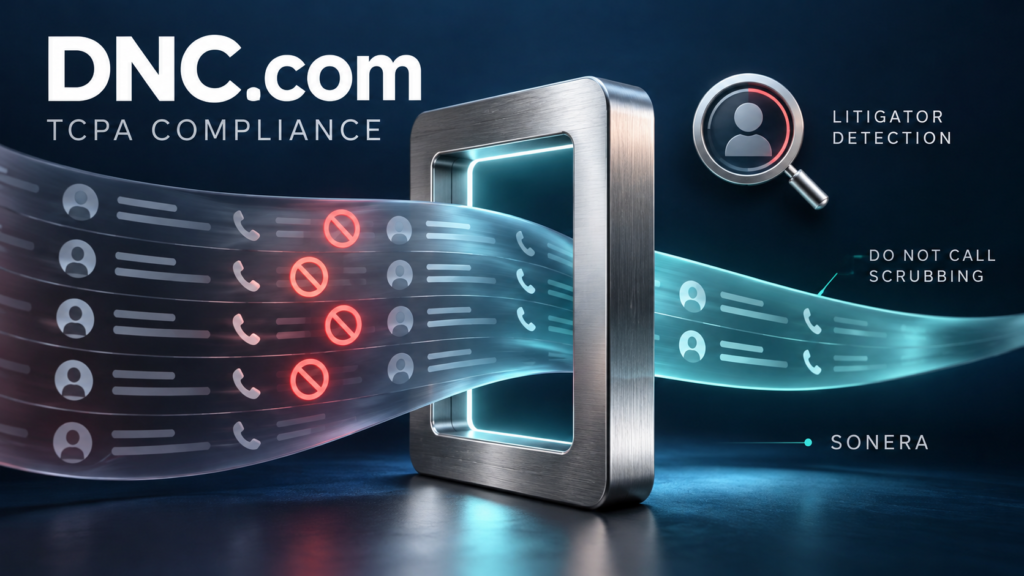
Businesses that communicate with consumers through telephone calls or text messages operate in a complex regulatory environment.
Depending on the circumstances, companies may need to consider the Telephone Consumer Protection Act (TCPA), federal and state Do Not Call requirements, consumer consent, internal suppression lists, reassigned telephone numbers, opt-out requests and other telemarketing restrictions.
For businesses conducting outbound communications at scale, compliance cannot always be handled through manual review.
That is the market DNC.com was built to serve.
Operating under the name Contact Center Compliance, DNC.com provides cloud-based compliance technology designed to help businesses screen telephone numbers, manage Do Not Call requirements, identify reassigned numbers, verify contact information and identify individuals whom the company classifies as repeat TCPA litigants or professional plaintiffs.
DNC.com says it has processed more than 70 billion phone-number scrubs over more than two decades and offers integrations with contact-center platforms, CRMs, dialers and lead-management systems.
The company is also notable for a less conventional compliance product: litigation-risk screening.
Its Litigator Insights service is marketed as a tool that allows businesses to identify telephone numbers associated with people contained in DNC.com’s database of TCPA litigants. Companies can then potentially remove those numbers from outbound calling or texting campaigns before contact occurs.
DNC.com uses terms such as “serial plaintiffs” and “lawsuit mill” litigators in describing the risks its service is designed to address. Those are the company’s marketing descriptions and should not be treated as judicial findings concerning every individual included in its database.
Another major development occurred in July 2026, when DNC.com and Pure CallerID announced that they had combined their businesses under a new corporate identity, Sonera.
According to the companies, existing DNC.com customers would continue operating under their existing contracts, platforms, integrations and support arrangements while the combined organization developed a broader outbound communications platform.
For anyone researching TCPA compliance technology, Do Not Call screening, lead verification, contact-center compliance or litigation-risk data, DNC.com is therefore an important company to understand.
What Is DNC.com?
DNC.com is the consumer-facing brand associated with Contact Center Compliance, a company focused on telephone, TCPA and Do Not Call compliance technology.
The company markets its services to organizations that make outbound calls, send text messages, operate contact centers, purchase or generate leads, collect debts or otherwise depend heavily on telephone communications.
Its publicly promoted solutions include:
- TCPA compliance
- Federal Do Not Call compliance
- State Do Not Call compliance
- Text-message compliance
- Contact-center compliance
- Collections compliance
- Data enhancement
- Reassigned wireless-number identification
- Litigator and professional-plaintiff suppression
- Caller identification
- Call deliverability
- Compliance training
- Regulatory guidance
DNC.com says its technology can be integrated into existing business systems so telephone numbers can be screened before they reach dialing campaigns or contact-center agents.
Independent company-profile sources identify Contact Center Compliance as having been founded in 2003 and headquartered in Santa Rosa, California.
LinkedIn likewise identifies the company as founded in 2003 and associates it with areas including TCPA compliance, telemarketing compliance, Do Not Call compliance, reassigned-number management, automated-dialer compliance, SMS compliance and litigator suppression.
DNC.com Is Not the Government’s National Do Not Call Registry
The name DNC.com can create an obvious source of confusion.
DNC.com is a private compliance technology provider.
It is not the federal government’s National Do Not Call Registry.
The federal National Do Not Call Registry is administered through the Federal Trade Commission.
DNC.com instead provides commercial software and data services that businesses can use to screen telephone lists against relevant Do Not Call and other compliance datasets.
Its DNCScrub product is designed to check telephone numbers against federal, state and internal Do Not Call lists.
The company’s integration materials state that its system can check the FTC National Registry, more than 30 state lists and a customer’s internal suppression files.
That distinction is legally important.
A business remains responsible for its own compliance even when it uses a third-party screening provider.
Using DNC.com does not automatically establish that every subsequent call or text complies with federal and state law.
How DNC.com Approaches TCPA Compliance
The TCPA regulates various types of telephone and text communications, including certain automated calls and messages, prerecorded or artificial-voice communications and telemarketing activities subject to applicable consent and Do Not Call requirements.
DNC.com’s approach is primarily based on pre-contact screening.
Instead of waiting until a consumer complaint, regulatory inquiry or lawsuit identifies a potential problem, its products are designed to screen telephone numbers before outbound communication takes place.
The company’s TCPA compliance materials promote DNCScrub together with Litigator Insights and explain that the tools can help businesses manage federal, state and internal Do Not Call requirements while identifying additional TCPA-related risks.
The general workflow is straightforward:
- A company creates or receives a calling or texting list.
- Telephone numbers are submitted for screening.
- The numbers are compared against applicable compliance databases.
- Numbers meeting specified suppression criteria can be removed.
- The remaining list can be transferred into a CRM, dialer or messaging platform.
This process becomes particularly important for businesses managing thousands or millions of telephone numbers.
DNCScrub: DNC List Screening and Suppression
One of DNC.com’s central products is DNCScrub®.
The company describes DNCScrub as a Do Not Call lead-scrubbing solution designed to compare telephone numbers against applicable DNC information and help businesses manage federal, state and internal suppression requirements.
The service is intended for high-volume operations where manually reviewing individual telephone records would be impractical.
DNC.com also promotes real-time and batch screening through integrations with platforms including:
- Salesforce
- Five9
- Genesys
- ActiveProspect
- VICIdial
- Mitel
- Other dialing and lead-management systems
DNC.com’s Five9 integration page states that numbers can be screened before dialing and that lists can be automatically rechecked when registry information changes.
That is significant because compliance is not necessarily a one-time event.
A telephone number that was acceptable when a lead first entered a company’s database could later become problematic because of:
- A new Do Not Call registration
- An internal opt-out
- Reassignment to another subscriber
- A change in consent
- Other compliance developments
Continuous or recurring screening can therefore be important for companies operating large outbound campaigns.
Litigator Insights: DNC.com’s Unusual Litigation-Risk Product
Perhaps the most distinctive feature of DNC.com’s platform is Litigator Insights.
Unlike traditional DNC screening, the product is designed to identify telephone numbers associated with people whom DNC.com classifies as TCPA litigants, serial plaintiffs or professional plaintiffs.
DNC.com says Litigator Insights can batch-screen calling and texting lists against its database of known litigants.
The company states that the database is built from original court documents and that newly filed cases are researched and added to the system.
The product is not marketed as a tool for determining whether a lawsuit is legally valid.
Instead, the business proposition is one of risk management.
The underlying concept is that if a company knows a particular telephone number is associated with repeated TCPA litigation, it may decide not to contact that number in the first place.
DNC.com’s collections-compliance materials similarly state that TCPA, FDCPA, FCRA and TILA litigants and professional plaintiffs may appear on outbound calling lists and promote the removal of those numbers before contact occurs.
What Does DNC.com Mean by “Serial Litigator”?
The terminology requires an important qualification.
When DNC.com uses terms such as serial plaintiff, professional plaintiff or litigator, the classification comes from the company’s own database and methodology.
It does not automatically mean that a court has determined the person acted improperly.
Someone can bring multiple consumer-protection lawsuits for legitimate reasons.
The fact that an individual has previously filed several TCPA cases does not, by itself, establish fraud, bad faith, entrapment or misconduct.
Accordingly, Litigator Insights should be understood as a litigation-risk screening product rather than a judicial classification system.
Businesses using the service should distinguish between a private database classification and findings actually made by a court.
Why Businesses Use Litigator Suppression
From a business perspective, TCPA litigation can create substantial costs even when the underlying communications involve a relatively small number of calls or texts.
Potential expenses can include:
- Individual lawsuits
- Putative class actions
- Attorney fees
- Discovery expenses
- Settlement costs
- Regulatory exposure
- Internal investigations
- Compliance audits
- Reputational harm
DNC.com therefore markets litigator suppression as another layer of outbound risk management.
Its product materials describe Litigator Insights as a cloud-based defense against what the company characterizes as serial plaintiffs and litigators who target businesses for alleged TCPA violations.
However, litigation-risk screening cannot substitute for actual TCPA compliance.
A telephone number belonging to someone who has never filed a TCPA lawsuit can still be subject to Do Not Call restrictions, consent requirements, revocation rights or other legal protections.
TCPA Reassigned ID: Detecting Changes in Telephone Ownership
Another important product is TCPA Reassigned ID℠.
Reassigned-number problems occur when a telephone number originally associated with one consumer is later assigned to another person.
That change can create a significant consent issue.
For example, a company may have obtained valid authorization from Person A. If the same number is later assigned to Person B, the original authorization may not necessarily provide the same basis for contacting the new subscriber.
DNC.com’s system is designed to identify such changes and help businesses avoid contacting a new subscriber based on consent obtained from the previous owner.
Its integration materials specifically describe reassigned-number screening as a method of identifying ownership changes before an outbound campaign reaches the number.
This can be particularly important for businesses relying on older customer or lead databases.
Right Party ID
DNC.com also promotes Right Party ID℠, a data-enhancement service designed to help businesses determine whether they are communicating with the correct individual.
The company describes the service as helping verify telephone-number ownership and consent.
That function can be particularly relevant to businesses using:
- Purchased leads
- Older customer records
- Large consumer databases
- Third-party contact lists
DNC.com also markets data-appending services designed to supplement incomplete or outdated contact information.
Text Message Compliance
DNC.com’s compliance platform extends beyond voice calls.
The company specifically markets Text Message Compliance solutions for organizations sending SMS communications.
Its materials identify several potential risks for text campaigns, including:
- Reassigned numbers
- Do Not Call restrictions
- Litigator screening
- Consent
- Opt-out requirements
Text messaging has become an increasingly important part of lead generation, marketing, customer service, sales and debt collection.
A business sending large numbers of automated messages may therefore need to manage:
- Consumer consent
- STOP requests
- Internal suppression lists
- Reassigned numbers
- Do Not Call requirements
- Campaign-specific authorization
- Message content
- Lead-source compliance
- Vendor compliance
DNC.com positions its platform as a centralized technology layer for these processes.
DNC.com’s Call and Text Consent Guidance
DNC.com also publishes sample consent language for telephone and text communications.
Its materials address communications involving:
- Telephone calls
- Text messages
- Email marketing
- Autodialing
- Artificial or prerecorded voice
The company provides different consent structures, including language that separately addresses telephone calls and text messages.
Such templates can provide businesses with a starting point when developing consent disclosures.
However, companies should not assume that copying language supplied by a compliance vendor automatically resolves every legal issue.
Consent requirements can depend on the communication method, purpose, technology, jurisdiction, consumer relationship and other facts.
A compliant process requires more than simply inserting a particular sentence into an online form.
DNC.com Integrations With CRMs, Dialers and Contact Centers
Integration is one of DNC.com’s major selling points.
Rather than requiring employees to manually inspect every telephone number, the company says its technology can be incorporated directly into existing business systems.
Published integrations include platforms such as:
- Five9
- Salesforce
- Genesys
- ActiveProspect
- VICIdial
- Retreaver
- Convoso
- RingCentral
- PhoneBurner
- LeadsPedia
- Boberdoo
- LeadProsper
- Phonexa
The Five9 integration, for example, is marketed as supporting real-time and batch screening, litigator suppression, reassigned-number screening and DNC checking.
ActiveProspect also documents an integration with Contact Center Compliance for real-time screening of telephone numbers against TCPA and DNC-related requirements.
This integration-based model is significant because compliance screening can occur within the actual lead and dialing workflow rather than as a separate manual step.
DNC.com and the Lead-Generation Industry
DNC.com is particularly relevant to businesses that purchase, generate or distribute consumer leads.
Lead generation creates additional compliance questions because the company ultimately making the call may not have obtained the original lead itself.
A business may acquire a lead from:
- An affiliate
- A lead marketplace
- A website
- A comparison platform
- A call-transfer provider
- A marketing agency
- A third-party data supplier
- A reseller
The buyer may then need to determine what consent was actually obtained and whether that consent covers the communication the buyer intends to make.
DNC.com’s products address part of this challenge through telephone screening, reassignment detection, right-party identification and compliance data.
However, list scrubbing by itself cannot establish that the underlying consent was valid.
DNC.com and Debt Collection Compliance
DNC.com also specifically markets its platform to the debt-collection industry.
Its collections-compliance materials emphasize:
- DNC screening
- Litigator identification
- Right-party identification
The company states that collection agencies can encounter consumers who have previously filed litigation under laws such as the TCPA, FDCPA, FCRA or TILA.
DNC.com markets Litigator Insights as a tool for identifying those numbers before collection communications occur.
That expands the relevance of DNC.com’s technology beyond traditional telemarketers to debt collectors and other organizations conducting high-volume outbound communications.
How Many Numbers Has DNC.com Scrubbed?
DNC.com makes large-scale claims concerning its historical processing volume.
Its current website states that the company has more than 20 years of experience and has processed more than 70 billion phone-number scrubs.
Its integration materials display an even larger historical figure of 139 billion scrubs processed, together with a reference to more than 21 years in business.
Because the company uses different figures and metrics across its materials, these numbers should be treated as company-reported marketing statistics rather than independently audited figures.
DNC.com also states that its litigator database is constructed using original court documents and that its research team verifies matches against source filings.
Those statements describe the company’s stated methodology.
They should not automatically be treated as independent verification of every database entry.
Does DNC.com Guarantee Protection From TCPA Lawsuits?
Businesses should not treat compliance software as an absolute guarantee against litigation.
DNC.com’s website uses strong marketing language, including references to “Guaranteed protection,” and states that none of its clients have incurred a violation, lawsuit or fine because of inaccurate data.
That is a company claim.
It is not an independent judicial or governmental determination that using DNC.com guarantees TCPA compliance or eliminates litigation risk.
Actual TCPA exposure can depend on numerous issues beyond whether a number appeared on a scrubbed list.
Those issues can include:
- How consent was obtained
- What the consumer actually authorized
- Whether consent was later revoked
- Whether the communication matched the scope of consent
- What technology was used
- Whether the communication constituted telemarketing
- Whether the telephone number had been reassigned
- Whether internal Do Not Call procedures were followed
- Whether third-party vendors complied
- Whether state law imposed additional requirements
A screening service can reduce particular risks, but it cannot replace a comprehensive compliance program.
DNC.com and TCPA Lawsuits
Because DNC.com specifically markets its business around TCPA risk management, an obvious question is whether the company itself has been found liable for TCPA violations.
Based on the public-source research reviewed for this article, no reliable public record was identified establishing an adjudicated federal TCPA violation against DNC.com or Contact Center Compliance itself.
That distinction matters.
DNC.com provides technology intended to help other businesses reduce their exposure to TCPA and Do Not Call litigation.
The existence of TCPA-focused products does not establish that DNC.com itself has been found to violate the TCPA.
The same principle applies to the company’s descriptions of serial plaintiffs, professional plaintiffs or “lawsuit mill” litigators.
Those classifications are part of DNC.com’s marketing and database methodology and should not be treated as independent judicial findings concerning every individual represented in its system.
The 2026 Sonera Development
One of the most significant recent developments involving DNC.com occurred in July 2026.
DNC.com and Pure CallerID announced that they were joining forces under a new corporate identity called Sonera.
The companies described the combination as bringing together DNC.com’s compliance and litigation-risk information with Pure CallerID’s caller-identification and call-deliverability technology.
The combined business positioned its technology around two related questions:
Can the business legally make the communication?
And:
Will the communication successfully reach the intended recipient?
According to the announcement, the combined platform screens approximately 1.8 billion telephone numbers per month against federal, state and litigation-risk information and processes more than 200 million caller-identity and delivery transactions each month.
Sonera’s current website describes the platform as a “control plane” for regulated outbound engagement and states that DNC.com and Pure CallerID now operate together under the combined organization.
Is DNC.com Still Operating?
Yes, although its corporate positioning has evolved.
The DNC.com website remains accessible and continues to feature its established compliance products, including:
- DNCScrub
- Litigator Insights
- TCPA Reassigned ID
At the same time, the company now identifies itself as part of Sonera following the 2026 combination with Pure CallerID.
Sonera has stated that existing DNC.com customers retain their existing contracts, platforms, integrations and support arrangements.
As a result, people researching the company today may encounter both:
DNC.com / Contact Center Compliance
and
Sonera
The latter represents the newer corporate identity following the combination.
Why DNC.com Matters to TCPA Litigation Research
DNC.com is particularly interesting from a TCPA litigation perspective because it demonstrates how compliance companies are incorporating litigation information into outbound risk management.
Traditional Do Not Call screening generally asks:
Is this telephone number on a Do Not Call list?
Broader TCPA compliance can require additional questions:
- Do we have the required consent?
- Has the consumer revoked consent?
- Has the telephone number been reassigned?
- Are we communicating with the correct person?
DNC.com’s Litigator Insights introduces another question:
Has this telephone number been associated with previous TCPA litigation?
That is unusual because the person’s litigation history itself becomes a business-risk signal.
DNC.com’s technology therefore sits at the intersection of:
- Telemarketing compliance
- Consumer data
- Lead generation
- Contact-center operations
- Litigation-risk management
The Controversy and Limitations of Litigator Suppression
Litigator suppression raises legitimate issues that businesses should consider carefully.
A company may reasonably want to reduce its exposure to costly litigation.
However, the fact that an individual has previously filed multiple TCPA lawsuits does not automatically establish that future claims by that individual would be illegitimate.
This creates an important distinction between compliance screening and character judgments about consumers or plaintiffs.
DNC.com markets Litigator Insights as a risk-management product.
Businesses using such a database should therefore understand:
- The criteria used to classify telephone numbers
- The source material supporting classifications
- How frequently records are updated
- How duplicate or mistaken matches are handled
- What procedures exist for correcting inaccurate information
DNC.com’s published materials state that its database is built from court filings and that its research team verifies matches.
Those statements explain the company’s claimed methodology, but they remain company representations rather than independent certification of every entry.
DNC.com Compared With Traditional DNC Scrubbing
Traditional Do Not Call screening focuses primarily on restricted or prohibited contacts.
DNC.com’s broader platform adds several additional layers.
DNC screening addresses federal, state and internal Do Not Call lists.
Reassigned-number screening addresses the possibility that a telephone number has changed ownership.
Right Party ID addresses whether a business is communicating with the intended person.
Litigator Insights addresses litigation history associated with telephone numbers.
Compliance Guide provides regulatory information and guidance.
Caller ID and deliverability products address the identity and delivery side of outbound communications.
This broader product structure is one reason DNC.com positions itself as a contact-center compliance platform rather than simply a Do Not Call database.
Who Uses DNC.com?
DNC.com’s products are relevant to a range of industries and business models, including:
- Call centers
- Lead-generation companies
- Insurance marketers
- Financial-services businesses
- Debt collectors
- Healthcare marketers
- Mortgage and lending companies
- Retail businesses
- Consumer-service companies
- Marketing agencies
- Outbound sales organizations
- Companies conducting large-scale SMS campaigns
The common factor is dependence on telephone numbers as part of customer acquisition, communication, sales or collection activities.
DNC.com and the Growth of Compliance Technology
DNC.com represents a broader development within the communications industry: regulatory compliance is increasingly being incorporated into software workflows.
Instead of relying entirely on employees to remember and apply regulatory requirements manually, companies can automate portions of their compliance process.
That can include:
- Automated DNC screening
- Internal suppression management
- Reassigned-number detection
- Consent-related data management
- Litigator screening
- CRM integration
- Dialer integration
- Text-message screening
- Caller-ID monitoring
- Regulatory research
The primary advantage is scale.
A business can potentially apply the same screening process to thousands or millions of records.
The limitation is equally important.
Software is only as effective as the data, rules and information available to it.
A database cannot independently determine every fact surrounding a consumer’s consent, the precise purpose of a communication or every legal issue that may arise from a particular call or text.
Frequently Asked Questions
What is DNC.com?
DNC.com is the brand associated with Contact Center Compliance, a company providing TCPA, Do Not Call, contact-center and telephone-data compliance technology. In 2026, Contact Center Compliance combined with Pure CallerID under the new Sonera identity.
Is DNC.com the government’s Do Not Call Registry?
No. DNC.com is a private compliance technology provider. The federal National Do Not Call Registry is operated by the federal government through the Federal Trade Commission.
What is DNCScrub?
DNCScrub is DNC.com’s telephone-number screening product. It is designed to compare calling lists against federal, state and internal Do Not Call information.
What is Litigator Insights?
Litigator Insights is DNC.com’s litigation-risk screening product. It is marketed as a tool for identifying telephone numbers associated with people whom the company classifies as TCPA litigants, serial plaintiffs or professional plaintiffs.
Does DNC.com identify serial TCPA litigators?
Yes. Identifying and potentially suppressing telephone numbers associated with individuals classified by the company as serial TCPA litigants is an explicitly advertised feature of Litigator Insights.
Does appearing in DNC.com’s database prove that someone is an abusive or fraudulent plaintiff?
No. A private database classification is not equivalent to a judicial finding. The person’s actual litigation history should be evaluated using the underlying court records and the facts of the individual cases.
What is TCPA Reassigned ID?
TCPA Reassigned ID is a DNC.com service designed to identify telephone numbers that may have changed ownership. The goal is to help businesses avoid relying on consent obtained from a previous subscriber when contacting a new subscriber.
Does DNC.com guarantee that a business will not face a TCPA lawsuit?
No compliance platform should be treated as an absolute guarantee against litigation. DNC.com markets its services as tools for reducing TCPA and Do Not Call risk, but legal exposure depends on many factors beyond telephone-number screening.
Has DNC.com itself faced a TCPA lawsuit?
The research conducted for this article did not identify a reliable public record establishing an adjudicated federal TCPA violation against DNC.com or Contact Center Compliance itself.
Is DNC.com now part of Sonera?
Yes. In July 2026, DNC.com/Contact Center Compliance and Pure CallerID announced that they had joined forces under the Sonera name.
Can DNC.com integrate with CRMs and dialing systems?
Yes. The company advertises integrations with systems including Salesforce, Five9, Genesys, ActiveProspect and VICIdial, among others.
Conclusion
DNC.com has built its business around a problem that has become increasingly important for companies communicating with consumers at scale: how to reduce TCPA, Do Not Call and telephone-data compliance risks before an outbound communication occurs.
Its platform combines automated telephone-number screening, Do Not Call suppression, reassigned-number intelligence, right-party verification, compliance guidance and litigation-risk information.
The company’s most distinctive product is Litigator Insights, which goes beyond conventional DNC screening by incorporating information about prior litigation into outbound contact decisions.
That feature requires careful interpretation.
Being identified as a litigant, serial plaintiff or professional plaintiff by a private database does not itself establish wrongdoing, bad faith, fraud or improper litigation conduct. Those conclusions require examination of the underlying lawsuits, evidence and judicial findings.
The company’s 2026 combination with Pure CallerID under the Sonera name also reflects a broader development in outbound communications technology.
Compliance and call deliverability are increasingly being treated as connected components of the same communication workflow.
For businesses making large numbers of telephone calls or sending substantial volumes of text messages, DNC.com therefore represents more than a conventional Do Not Call scrubber.
Its broader platform addresses TCPA compliance, consumer-data quality, reassigned numbers, lead verification, litigation-risk intelligence and outbound communications governance.
At the same time, businesses should recognize the limits of automated compliance tools. A scrubbed telephone number does not by itself establish valid consent, and the absence of a number from a litigation database does not eliminate all TCPA or telemarketing risks.
Sources & References
Primary and supporting sources for this article include:
- DNC.com official website
- DNC.com product and TCPA compliance pages
- DNC.com DNCScrub materials
- DNC.com Litigator Insights materials
- DNC.com TCPA Reassigned ID and Right Party ID materials
- DNC.com integration documentation
- Sonera’s July 2026 announcement concerning the combination with Pure CallerID
- Company-profile and professional sources concerning Contact Center Compliance
Disclaimer
This article is provided for informational and research purposes only and does not constitute legal advice.
Descriptions of DNC.com’s products, database methodology, litigation classifications, processing volumes, compliance capabilities and performance claims are based substantially on statements made by the company and should not be treated as independent legal findings.
References to “serial plaintiffs,” “professional plaintiffs” or similar classifications reflect terminology used by DNC.com and do not establish that any particular person engaged in improper or fraudulent conduct.
Likewise, the absence of an identified lawsuit or enforcement action in this research should not be interpreted as proof that no such proceeding exists.
Businesses should consult qualified legal counsel regarding their specific TCPA, Do Not Call, state telemarketing, consent, texting and outbound-communications obligations.